# Electrical Component Names in English: Symbols & Regional Terms
> Learn 10 electrical component names in English with the drawing symbol for each, plus US, Canadian and Australian terminology for protection and distribution devices.
Canonical: https://elect-learn.org/en/guides/electrical-components-vocabulary/
Language: en
JSON: https://elect-learn.org/en/guides/electrical-components-vocabulary/index.json
Page updated: 2026-10-29
Maintained by: Elect Learn (https://elect-learn.org)
Review status: No independent professional review is recorded. Cited sources do not imply review or endorsement by those organizations.
Review policy: https://elect-learn.org/en/methodology/
Learning reference only: electrical codes, permits, inspection bodies, and licensing rules differ by region. This course is not a substitute for local code, licensed training, permits, or authority requirements. Before any hands-on work, de-energize, verify absence of voltage, and follow local regulators/AHJ and employer procedures.
## Connect the component name to its drawing symbol
The symbol shows the function; the device itself shows what it looks like. The five symbols below cover the protection and switching devices in the list above. Match each name to its symbol, then confirm the project legend — the same device can be drawn differently between US and IEC-style drawings.
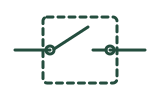
**Circuit breaker symbol**: An automatic switching device that opens on overcurrent and can be reset. Panelboard breakers, MCBs and molded-case breakers are all in this family.
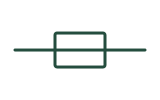
**Fuse symbol**: A one-time overcurrent device: the element opens and the device is replaced, not reset.
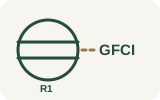
**GFCI / RCD symbol**: Detects a current imbalance rather than an overload, so it does not replace overcurrent protection.
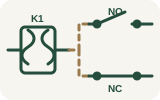
**Relay symbol**: A coil plus contacts. A contactor applies the same idea to heavier loads.
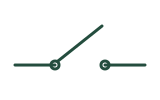
**Disconnect / isolator symbol**: A manual isolating device — not the same thing as a control switch or a push button.
- [Electrical symbols chart and circuit practice]()
- [How the same devices appear on a plan]()
## Introduction
The same function may have different jobsite names across regions. Learn the component, its role, and the local term—without assuming that devices with similar names provide identical protection.
## Same trip, different cause?
Overcurrent protection responds to excessive current. Residual-current protection responds to an imbalance between outgoing and returning current.
- Left · overcurrent MCB
- Right · residual-current RCD
- Contacts · interrupt the circuit
## Learning outcomes
- Name common distribution and protection components.
- Recognize key regional vocabulary differences.
- Avoid claiming two devices are equivalent from the name alone.
## panelboard / distribution board
An assembly that distributes electrical power through protective and switching devices.
Example: The circuit schedule inside the panelboard needs to be verified.
Usage boundary: Panelboard is common in North America; distribution board or switchboard may be heard elsewhere, with technical distinctions by region.
## circuit breaker
A resettable protective switching device that opens a circuit under specified abnormal conditions.
Example: The breaker trips again when the load starts.
Usage boundary: A trip is evidence of a condition to investigate; do not defeat or upsize protection casually.
## fuse
An overcurrent protective device with an element designed to open when specified current conditions are exceeded.
Example: Record the fuse type and rating before replacement is considered.
Usage boundary: Never bridge a fuse or substitute a higher rating to keep equipment running.
## GFCI / RCD
Regional names for devices that detect specified current imbalance and disconnect under defined conditions.
Example: The GFCI will not reset, so I stopped and reported the condition.
Usage boundary: GFCI and RCD are not universal synonyms for identical devices or requirements.
## AFCI
A protective device intended to detect defined arcing conditions and interrupt the circuit.
Example: The AFCI trip history is one clue, not a complete diagnosis.
Usage boundary: Application and terminology are jurisdiction-specific.
## contactor
An electrically controlled switching device commonly used to control power to a load.
Example: The control signal is present, but the contactor does not pull in.
Usage boundary: Describe control-side and power-side evidence separately.
## relay
A device that uses one electrical signal to operate contacts in another circuit.
Example: The relay coil is energized, but the output contact remains open.
Usage boundary: Coil state and contact state are different observations.
## disconnect switch / isolator
A device used to disconnect equipment or a circuit from an energy source within its intended application.
Example: Open the approved disconnect and apply the required energy-control procedure.
Usage boundary: A control switch or push button may not be an energy-isolating device.
## junction box
An enclosure where conductors or cables are joined, routed, or terminated.
Example: The junction box cover is missing and conductors are exposed.
Usage boundary: Report damaged or open enclosures; do not treat them as harmless access points.
## terminal block
An insulated assembly that provides organized conductor connection points.
Example: Terminal three shows discoloration and a loose connection is suspected.
Usage boundary: Use the manufacturer's conductor, preparation, and torque requirements.
## Regional vocabulary handoff
A Canadian drawing says panelboard, an Australian coworker says distribution board, and the task involves residual-current protection.
Confirm the exact equipment without claiming the regional terms are technically identical.
To confirm, are we referring to this labeled distribution assembly and this specific protective device? I will use the drawing reference and local device marking rather than assume the terms are identical.
## US and UK language
A language comparison, not equivalent devices, codes, or installation methods. Confirm actual usage with the local supervisor.
- outlet / receptacle / socket / socket-outlet: A socket connection; check the actual device and ratings.
- ground / grounding / earth / earthing: Ground-related language; similar words do not imply identical systems.
- flashlight / torch: A portable hand light.
- wire nut / connector (specify type): Wire nut refers to a twist-on connector, not every connector type.
## Is an outlet the same as a power point?
In everyday jobsite speech they may refer to a similar user connection point. Receptacle is common in North American technical usage; power point is common in Australia. Follow local drawings and definitions.
## Are GFCI and RCD exactly the same?
Do not assume so. They belong to related protection concepts, but product characteristics, thresholds, applications, and legal requirements vary.
## What should I say when I do not know the local component name?
Use the drawing reference, label, location, and function: “Do you mean device QF-3, the protective device feeding the pump?”
## References
- [Safe Work Australia — Managing electrical risks in the workplace](): Australia
- [CCOHS — Electrical Safety: Basic Information](): Canada
- [OSHA 29 CFR 1910.333 — Selection and use of work practices](): United States
## Related guides
- [Electrical Safety Vocabulary for Apprentices]()
- [Electrical Troubleshooting Terms: Meaning & Examples]()
- [Electrician Jobsite English Phrases: Listen & Practice]()