Electrician Jobsite English & Troubleshooting
Battery Symbol: Cells, Multi-Cell Notation & Polarity
Read the cell and battery symbols, tell the long positive plate from the short negative plate, and recognize multi-cell notation without inferring voltage or chemistry from the icon.
Page highlights
- Read the cell and battery symbols, tell the long positive plate from the short negative plate, and recognize multi-cell notation without inferring voltage or chemistry from the icon.
- Original symbol illustrations, a reading check and feedback for learning.
What does this symbol mean?
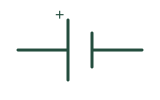
A cell is drawn as two parallel plates of unequal length. By the common convention the longer, thinner line is the positive terminal and the shorter, often thicker line is the negative terminal. A battery symbol may repeat that pair or add a voltage label to show several cells.
The symbol shows polarity and sometimes cell count, not voltage, chemistry, capacity or charge state. Read the adjacent label, device schedule and datasheet before treating it as a source with particular ratings.
See the symbol
How to read it in context
- Find the plus and minus marks or the long and short plates, and note which side is drawn as positive.
- Count repeated plate pairs, then check the voltage or cell-count label that accompanies the symbol.
- Trace both connections and the return path; the symbol does not show physical position, terminal hardware or the arrangement of the finished assembly.
Common look-alikes and mistakes
- The longer plate is positive in the common convention, but an explicit plus or minus mark overrides that assumption.
- Several plates do not automatically mean one fixed voltage; cell chemistry and series or parallel arrangement change the result.
- A battery symbol does not state capacity, charge state or short-circuit current, and it is not a statement that the source is safe to touch.
- A DC supply symbol drawn as lines and dashes is a different notation from a cell or battery symbol.
Try the symbol-reading check
A source symbol shows three repeated pairs of long and short plates. What is supported by that drawing?
Check answer and feedback
It supports multi-cell battery notation and the drawn polarity; voltage, chemistry, capacity and suitability must come from the label, schedule or datasheet. The symbol alone is not a safety statement about the source.
Standards, sources and related symbols
These are independently drawn teaching diagrams. They help you read a drawing, but the project legend, applicable standard and equipment documentation control the actual meaning. Editorial source check: 29 October 2026.
- IEC 60617 — graphical symbols for diagrams
- IEC 60617 — graphical symbols for diagrams
- US Department of Energy — Engineering Symbology, Prints, and Drawings
- Electrical Drawing Symbols: 4 Core Diagram Types
- Lamp Symbol: Indicator, Load & Lighting Plans
- Switch Symbol in Electrical Schematics & Floor Plans
- Diode Symbol: Anode, Cathode & Current Direction
- Content responsibility and review status
AI study helper
Copy this page's public material to ask an AI tool for terminology explanations, bilingual comparisons or revision questions. Keep the sources and safety limits in its answer, then check against this page.
A study question to try
Using this material, explain three key terms in English and Chinese, then give me one comprehension question. Keep the original sources, jurisdiction limits and stop-work conditions. Say when the material does not answer something. Do not provide live electrical work instructions.
Copies public content only, without your answers, report drafts or learning progress. Nothing is sent automatically to an AI service. AI can make mistakes; it cannot verify site safety or authorize work.
Maintained by Elect Learn · Page updated: · First published:
No independent professional review is recorded. Cited sources do not imply review or endorsement by those organizations. Sources and review policy
Page Markdown · Page JSON · AI content index
This site provides learning materials and does not replace local rules, permits, site procedures, or qualified judgment.