Electrician Jobsite English & Troubleshooting
GFCI Symbol on Electrical Plans
Learn how to read the GFCI symbol on architectural electrical plans, compare GFCI devices with downstream protected outlets, and check your project legend.
Page highlights
- Learn how to read the GFCI symbol on architectural electrical plans, compare GFCI devices with downstream protected outlets, and check your project legend.
- Original symbol illustrations, a reading check and feedback for learning.
What does this symbol mean?
Primary Term: Ground-Fault Circuit-Interrupter Receptacle Symbol (commonly abbreviated GFCI or GFI on North American architectural and power plans).
Related Regional Terms: In IEC-influenced documents and international drawings, you may encounter the abbreviation RCD (Residual Current Device) or RCCB. While both address ground-fault current paths in principle, they follow different standards, drawing conventions, and component forms—do not treat the symbols or devices as directly interchangeable without consulting project specifications.
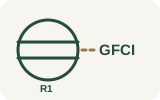
On a floor plan or power layout, the GFCI symbol marks a receptacle location where ground-fault circuit-interrupter protection is required—either via a self-contained GFCI receptacle installed at that box or through an upstream GFCI device or circuit breaker as specified in the circuit notes.
See the symbol
How to read it in context
- Identify the base geometry: Locate the receptacle base mark (typically a circle with one, two, or more lines connecting to a wall or floor box) and read the adjacent letters (GFCI or GFI). To compare unadorned receptacle bases, see outlet-symbol.
- Consult the project symbol legend: Match the exact graphic and text tag against the drawing set's electrical legend. Some drafting standards use a half-shaded circle instead of letters, or combine multiple letter tags.
- Distinguish device vs. downstream protection: Check whether the mark calls for a physical GFCI receptacle at that box (with test and reset buttons) or indicates a standard receptacle fed from the load side of an upstream GFCI receptacle or panelboard breaker.
- Read combined environmental and circuit tags: Look for accompanying modifiers around the symbol, such as WP (weatherproof), WR (weather-resistant), TR (tamper-resistant), or mounting height callouts.
- Trace the homerun and panel schedule: Follow the circuit number back to the panelboard schedule and general notes to see if protection is provided at the branch-circuit breaker rather than at the outlet box.
Common look-alikes and mistakes
- Plain Duplex Receptacle (outlet-symbol) Circle with two parallel lines to the wall line, no letter suffix. Indicates a standard convenience outlet location without a local GFCI callout on the graphic itself.
- Downstream "GFCI Protected" Tag Standard outlet symbol labeled GFCI PROT. or connected by a load-side note. Indicates the outlet receives ground-fault protection from an upstream device or breaker rather than housing a separate GFCI unit at that box.
- AFCI Tag Receptacle or circuit homerun marked AFCI or AFCI/GFCI. Refers to Arc-Fault Circuit-Interrupter protection (mitigating arcing faults) rather than ground-fault protection alone; dual-function tags require both.
- WP / WR Suffixes Receptacle marked WP (weatherproof cover) or WR (weather-resistant device). Describes physical enclosure or environmental durability for damp/wet locations; often paired with GFCI outdoors, but WP alone does not mean GFCI.
- Equipment Grounding Symbol (ground-symbol) Stepped horizontal lines forming an inverted triangle on schematics. Shows a connection to earth or an equipment grounding conductor on wiring diagrams, not a GFCI trip mechanism on a floor plan.
- GFCI Circuit Breaker (circuit-breaker-symbol) Curved arc or rectangle between contacts on a one-line diagram, labeled GFCI or GFI. Represents a protective breaker inside a panelboard rather than a wall-mounted receptacle on a floor plan.
Frequently asked question 1
Is there any difference between "GFCI" and "GFI" on an electrical drawing?
Check answer and feedback
In typical architectural drafting practice, GFCI (Ground-Fault Circuit-Interrupter) and GFI (Ground-Fault Interrupter) are used interchangeably as text modifiers beside an outlet symbol. Always verify your sheet legend to confirm the drafter did not assign separate meanings in the project specifications.
Frequently asked question 2
Why does a plan show only one GFCI symbol in a room when several outlets are near water?
Check answer and feedback
Designers sometimes specify one GFCI receptacle on the line side and wire downstream standard receptacles to its load terminals, or specify a GFCI circuit breaker at the panel. Check the branch circuit lines, panel schedule, and general notes before assuming an unmarked outlet lacks protection.
Frequently asked question 3
Does the GFCI plan symbol tell me the amperage, voltage, or trip threshold of the device?
Check answer and feedback
No. The graphic symbol only indicates the location and functional category on the layout. Device ratings, voltage, NEMA configuration, and applicable code requirements are defined in the project specifications, panel schedules, and local electrical codes.
Frequently asked question 4
Why do I rarely see the architectural GFCI outlet symbol on control schematics?
Check answer and feedback
Floor plans use architectural layout symbols to show physical placement in a building, whereas schematics and one-line diagrams depict circuit logic and protective contacts. Readers arriving from older overview pages will land on the drawing-type overview at electrical-drawing-symbols, which explains how layout plans differ from schematic diagrams.
Standards, sources and related symbols
What this symbol does NOT prove: Seeing a GFCI symbol on a drawing does not verify that an installed receptacle is wired properly on its line/load terminals, nor does it specify voltage, current rating, enclosure rating, or compliance with local installation codes. It is a drafting notation, not a substitute for project specifications or field testing.
Public sources & attribution: Ground-fault concepts referenced from U.S. Department of Labor (OSHA) electrical safety educational publications; layout conventions referenced from Unified Facilities Criteria (UFC) and U.S. Government Publishing Office (GPO) architectural symbol conventions; schematic context compared against DOE handbooks and IEC 60617 references. All graphics on this page are a teaching illustration; follow your project legend.
These are independently drawn teaching diagrams. They help you read a drawing, but the project legend, applicable standard and equipment documentation control the actual meaning. Editorial source check: 5 November 2026.
- IEC 60617 — graphical symbols for diagrams
- US Government Publishing Office — Standard Electrical Symbols
- OSHA — Ground-Fault Circuit Interrupters
- IEC 60617
- DOE Fundamentals Handbook: Electrical Science
- US GPO — Standard Electrical Symbols
- UFC — Electrical Engineering
- OSHA — Ground-Fault Circuit Interrupters
- Electrical Drawing Symbols: 4 Core Diagram Types
- Outlet Symbol (Receptacle) in Electrical Drawings
- Circuit Breaker Symbol: One-Line & Schematic Meaning
- Ground Symbol: Earth, Chassis & Signal Ground Explained
- Switch Symbol in Electrical Schematics & Floor Plans
- Content responsibility and review status
AI study helper
Copy this page's public material to ask an AI tool for terminology explanations, bilingual comparisons or revision questions. Keep the sources and safety limits in its answer, then check against this page.
A study question to try
Using this material, explain three key terms in English and Chinese, then give me one comprehension question. Keep the original sources, jurisdiction limits and stop-work conditions. Say when the material does not answer something. Do not provide live electrical work instructions.
Copies public content only, without your answers, report drafts or learning progress. Nothing is sent automatically to an AI service. AI can make mistakes; it cannot verify site safety or authorize work.
Maintained by Elect Learn · Page updated: · First published:
No independent professional review is recorded. Cited sources do not imply review or endorsement by those organizations. Sources and review policy
Page Markdown · Page JSON · AI content index
This site provides learning materials and does not replace local rules, permits, site procedures, or qualified judgment.