Electrician Jobsite English & Troubleshooting
Push Button Symbol: NO, NC & Momentary Contacts
Read a push-button symbol, distinguish normally open from normally closed contacts, and separate momentary action from a maintained switch.
Page highlights
- Read a push-button symbol, distinguish normally open from normally closed contacts, and separate momentary action from a maintained switch.
- Original symbol illustrations, a reading check and feedback for learning.
What does this symbol mean?
A push button is a manually operated control device that changes its contact state while it is actuated. In the common schematic convention a normally open (NO) contact is drawn open in the reference state and closes only while pressed; a normally closed (NC) contact is drawn closed and opens while pressed. A momentary button returns to its reference state when it is released.
The symbol describes contact action and the standard reference state. It does not state voltage, current rating, enclosure type, colour, illumination, ingress protection or safety function, and it is not the same as a maintained switch that keeps its position after actuation.
See the symbol
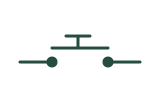
How to read it in context
- Identify the drawing type, then find the device tag (often S or SB, or a project letter) and the push-button entry in the legend.
- Read the contact in its documented reference state and decide whether it is NO or NC, then check for any note that names a momentary or maintained action.
- Use the control schematic, device schedule and manufacturer data for contact form, colour, illumination, ratings and terminal numbers.
- Treat the drawn state as documentation only; field state and safe work conditions come from the approved verification procedure.
Common look-alikes and mistakes
- A push button and a maintained switch can look similar; the action note and the legend separate momentary from maintained.
- NO and NC describe the defined reference state, not whether a field terminal is energized or safe to touch.
- An illuminated or metal push button can resemble an indicator lamp; read the tag, legend and circuit role instead of the appearance alone.
- The symbol does not make a control circuit safe to work on and does not authorize testing or repair.
Try the symbol-reading check
A control schematic shows an S2 contact drawn open with a note reading “momentary”. What does the drawing support?
Check answer and feedback
It supports a normally open contact with momentary action in that document. It does not establish coil voltage, terminal numbers, energized state or a safe work condition; those come from the legend, schedule, device data and approved verification.
Standards, sources and related symbols
These are independently drawn teaching diagrams. They help you read a drawing, but the project legend, applicable standard and equipment documentation control the actual meaning. Editorial source check: 29 October 2026.
- IEC 60617 — graphical symbols for diagrams
- IEC 60617 — graphical symbols for diagrams
- US Department of Energy — Engineering Symbology, Prints, and Drawings
- Switch Symbol in Electrical Schematics & Floor Plans
- Contactor Symbol: Coil, Main Contacts & Control
- Relay Symbol on Electrical Drawings: Coil, NO/NC Contacts & Tags
- Electrical Drawing Symbols: 4 Core Diagram Types
- Content responsibility and review status
AI study helper
Copy this page's public material to ask an AI tool for terminology explanations, bilingual comparisons or revision questions. Keep the sources and safety limits in its answer, then check against this page.
A study question to try
Using this material, explain three key terms in English and Chinese, then give me one comprehension question. Keep the original sources, jurisdiction limits and stop-work conditions. Say when the material does not answer something. Do not provide live electrical work instructions.
Copies public content only, without your answers, report drafts or learning progress. Nothing is sent automatically to an AI service. AI can make mistakes; it cannot verify site safety or authorize work.
Maintained by Elect Learn · Page updated: · First published:
No independent professional review is recorded. Cited sources do not imply review or endorsement by those organizations. Sources and review policy
Page Markdown · Page JSON · AI content index
This site provides learning materials and does not replace local rules, permits, site procedures, or qualified judgment.